

















1. LiFePO4 batteries - the basics
What are LiFePO4 batteries?
LiFePO4 batteries, also known as lithium iron phosphate batteries,
are rechargeable lithium-ion batteries. The name comes from the
abbreviations of the chemical elements lithium (Li), iron (Fe) and
phosphate (PO4). These batteries offer long life, high energy
density, improved discharge and charge efficiency and the ability to
handle high charge and discharge rates. LiFePO4 batteries are a
better option than other lithium-ion batteries due to their chemical
stability and environmental friendliness. These properties make
LiFePO4 batteries the preferred choice for use on boats and yachts.
What are the uses of LiFePO4 batteries on boats?
LiFePO4 batteries can reliably supply on-board lighting, navigation
instruments and other electronic devices on board with power.
Furthermore, they can be charged with renewable energy sources such
as wind or solar systems on sailing boats.
Can LiFePO4 batteries be used in combination with other battery
types?
It is not recommended to combine LiFePO4 batteries with other types
such as lead-acid or AGM batteries in series or in parallel.
Generally speaking, these batteries have different discharge currents
and charging methods.
But that doesn't mean you can't use different types of battery for different purposes on board. For example, a lead-acid or AGM battery works well as a starter battery, while a LiFePO4 battery can be used to power your devices and appliances.
But that doesn't mean you can't use different types of battery for different purposes on board. For example, a lead-acid or AGM battery works well as a starter battery, while a LiFePO4 battery can be used to power your devices and appliances.
Can you combine several LiFePO4 batteries of the same type?
LiFePO4 batteries of the same type and capacity can be connected
together. There are two methods for combining LiFePO4
batteries:
Parallel connection: Combining batteries in parallel is done by connecting positive to positive and negative to negative in order to increase the total capacity while keeping the voltage constant. It is important to ensure that all batteries have the same state of charge to avoid imbalances.
Series connection: This is where the batteries are connected positive to negative in order to increase the overall voltage. It is important that all batteries have the same internal resistance and capacity to ensure that the voltage is balanced and to avoid potential risks of overcharging or deep discharge.
However, please note the following:
Balancing: It is particularly important to ensure that all batteries are charged and discharged evenly when connected in series. This can be done using a battery management system (BMS), which monitors the voltage and charge level of each battery and regulates it accordingly.
Safety: When connecting several LiFePO4 batteries, it is important to observe safety measures to avoid short circuits and overheating. This includes using appropriate connection wires, insulation materials and protective devices such as fuses or protective circuits.
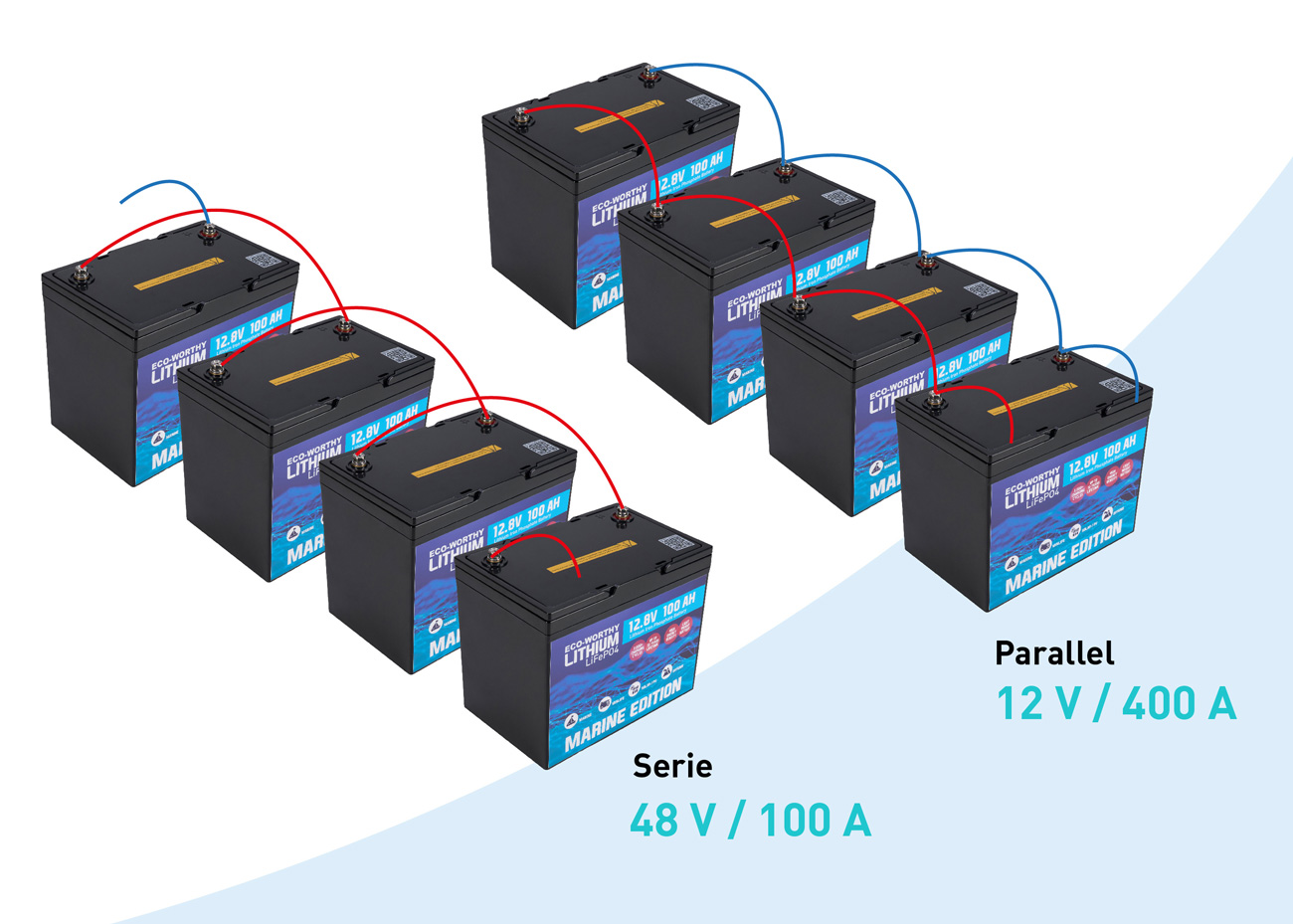
Parallel connection: Combining batteries in parallel is done by connecting positive to positive and negative to negative in order to increase the total capacity while keeping the voltage constant. It is important to ensure that all batteries have the same state of charge to avoid imbalances.
Series connection: This is where the batteries are connected positive to negative in order to increase the overall voltage. It is important that all batteries have the same internal resistance and capacity to ensure that the voltage is balanced and to avoid potential risks of overcharging or deep discharge.
However, please note the following:
Balancing: It is particularly important to ensure that all batteries are charged and discharged evenly when connected in series. This can be done using a battery management system (BMS), which monitors the voltage and charge level of each battery and regulates it accordingly.
Safety: When connecting several LiFePO4 batteries, it is important to observe safety measures to avoid short circuits and overheating. This includes using appropriate connection wires, insulation materials and protective devices such as fuses or protective circuits.
What should I know when building a LiFePO4 battery bank?
1. Only select batteries with the same voltage and capacity for a
battery bank.
2. Only use suitable connecting cables and plugs to avoid loose connections.
3. A battery management system (BMS) for LiFePO4 batteries is essential.
4. The BMS should have cell balancing, temperature monitoring and protection functions. Operate the battery bank within the manufacturer's recommended temperature range.
5. Ensure that the battery bank is sufficiently ventilated.
6. Implement safety precautions such as overcurrent and short-circuit protection.
7. Make sure there is an emergency shut-off switch.
2. Only use suitable connecting cables and plugs to avoid loose connections.
3. A battery management system (BMS) for LiFePO4 batteries is essential.
4. The BMS should have cell balancing, temperature monitoring and protection functions. Operate the battery bank within the manufacturer's recommended temperature range.
5. Ensure that the battery bank is sufficiently ventilated.
6. Implement safety precautions such as overcurrent and short-circuit protection.
7. Make sure there is an emergency shut-off switch.
Can the ambient temperature affect the performance of LiFePO4
batteries?
Yes, the ambient temperature can affect the performance of LiFePO4
batteries. It can have a significant impact, leading to a loss of
capacity and increased internal resistance in the case of low
temperatures, which limits performance and slows down charging and
discharging. Furthermore, low temperatures can impair the fast-
charging capability of LiFePO4 batteries, resulting in reduced
charging speed or damage. Both high and low temperatures accelerate
ageing processes, which shortens battery life. Extreme temperatures
harbour safety risks such as overheating or thermal failures,
especially if handled incorrectly. You can operate your batteries at
a temperature between 0 and 45 °C, the optimum and recommended
operating temperature range is between 5 and 35 °C.
Can a LiFePO4 battery also be used as a starter battery?
No, you should not use lithium iron phosphate batteries as a starter
battery for engines.
Can LiFePO4 batteries also be used to power an electric boat
motor?
Using LiFePO4s as an energy source for electric boat motors is not
recommended. High-performance lithium batteries are specially
designed for powering electric motors.
How long do LiFePO4 batteries last and what service life can be
expected?
You can expect more than 3000 charging cycles without loss of
performance and 10 years of service life or longer if batteries are
used correctly and in compliance with safety regulations, regular
maintenance and together with a BMS.
2. Installing LiFePO4 batteries
What should I know about installing LiFePO4 batteries on boats?
You should consider the following points when installing LiFePO4
batteries:
1. The battery must be fixed or mounted securely in the boat.
2. Ensure sufficient air circulation is possible.
3. The contacts of the batteries must be protected.
4. Attach connection cables firmly.
5. Only use compatible wires and make sure they are the required thickness.
6. Equip or connect the battery to a battery management system (BMS).
7. A battery balancer should ideally be connected in series.
8. Verify that wires are not broken or too long.
9. Batteries should be installed in the boat in such a way that there is no imbalance.
10. There should be protection against splashing water.
11. Install the battery in a location where large temperature differences do not occur.
1. The battery must be fixed or mounted securely in the boat.
2. Ensure sufficient air circulation is possible.
3. The contacts of the batteries must be protected.
4. Attach connection cables firmly.
5. Only use compatible wires and make sure they are the required thickness.
6. Equip or connect the battery to a battery management system (BMS).
7. A battery balancer should ideally be connected in series.
8. Verify that wires are not broken or too long.
9. Batteries should be installed in the boat in such a way that there is no imbalance.
10. There should be protection against splashing water.
11. Install the battery in a location where large temperature differences do not occur.
What capacity and power should the LiFePO4 battery have to meet the
specific requirements of my boat, and how can these be
determined?
The easiest way to determine the energy requirements of all your
devices and appliances on your boat, start by calculating the total
wattage of all consumers. Here's an example of how to calculate it:
Let us assume you have the following devices: An autopilot system with 45 watts, a navigation system with 15 watts, a radar system with 10 watts, navigation lights with 30 watts and a refrigerator with 80 watts.
The total wattage here is: 45 + 15 + 10 + 30 + 80 = 180 watts
If we assume that the appliances are operated for an average of 10 hours (we assume that the refrigerator does not run for the entire day), then the total energy requirement would be 180 W x 10 hours = 1800 watt hours (Wh).
The following formula must be used to determine the number of amp hours:
Amp hour (Ah) = Wh (watt hours) ÷ U (voltage (V)
In this case, we calculate 1800 Wh ÷ 12 V = 150 Ah
The battery, which is required for all appliances on board, must therefore have a capacity of at least 150 amp hours. If we also factor in reserve capacity, it makes sense in this example to use a battery with a capacity of 12V and 200 Ah.
Let us assume you have the following devices: An autopilot system with 45 watts, a navigation system with 15 watts, a radar system with 10 watts, navigation lights with 30 watts and a refrigerator with 80 watts.
The total wattage here is: 45 + 15 + 10 + 30 + 80 = 180 watts
If we assume that the appliances are operated for an average of 10 hours (we assume that the refrigerator does not run for the entire day), then the total energy requirement would be 180 W x 10 hours = 1800 watt hours (Wh).
The following formula must be used to determine the number of amp hours:
Amp hour (Ah) = Wh (watt hours) ÷ U (voltage (V)
In this case, we calculate 1800 Wh ÷ 12 V = 150 Ah
The battery, which is required for all appliances on board, must therefore have a capacity of at least 150 amp hours. If we also factor in reserve capacity, it makes sense in this example to use a battery with a capacity of 12V and 200 Ah.
What do I need to consider when wiring LiFePO4 batteries?
1. Use a fairly heavy gauge wire of good quality to avoid overheating
and the risk of fire.
2. Ensure correct polarity when connecting the batteries and components to prevent damage.
3. Solder or wire the connections to ensure strength and efficiency.
4. Insulate all connections carefully to prevent short circuits and electrical interference.
5. Keep the wiring neat and well organised to facilitate maintenance and troubleshooting.
6. Follow the instructions and recommendations of the BMS for the wiring and configuration of the battery bank.
2. Ensure correct polarity when connecting the batteries and components to prevent damage.
3. Solder or wire the connections to ensure strength and efficiency.
4. Insulate all connections carefully to prevent short circuits and electrical interference.
5. Keep the wiring neat and well organised to facilitate maintenance and troubleshooting.
6. Follow the instructions and recommendations of the BMS for the wiring and configuration of the battery bank.
How and with what should a LiFePO4 battery be protected?
1. Use fuses with the correct current rating that are matched to the
specific requirements of the LiFePO4 battery.
2. Place fuses at strategic points in the wiring to prevent short circuits and overcurrents.
3. Make sure you install overcurrent protection that switches off quickly in the event of an overload or short circuit to protect the battery and the system.
4. Integrate a BMS that offers protective functions such as over-discharge and deep-discharge protection, temperature monitoring and cell balancing.
2. Place fuses at strategic points in the wiring to prevent short circuits and overcurrents.
3. Make sure you install overcurrent protection that switches off quickly in the event of an overload or short circuit to protect the battery and the system.
4. Integrate a BMS that offers protective functions such as over-discharge and deep-discharge protection, temperature monitoring and cell balancing.
Are there any special requirements for the mounting position of
LiFePO4 batteries on a boat to ensure safety and performance?
Protection from water: The battery
should be installed on board the boat so as to avoid direct contact
with water.
Sufficient ventilation: Make sure that there is sufficient ventilation to support heat dissipation and protect the battery from overheating
Stability: The battery must be securely fixed to prevent it from becoming dislodged when the vessel is moving.
Balance: Take care that multiple batteries are positioned in such a way that the weight of the batteries does not unbalance the boat.
Insulation: Avoid placing near materials that are highly flammable.
Electrical connections: The electrical connections should be properly insulated and protected from moisture.
Sufficient ventilation: Make sure that there is sufficient ventilation to support heat dissipation and protect the battery from overheating
Stability: The battery must be securely fixed to prevent it from becoming dislodged when the vessel is moving.
Balance: Take care that multiple batteries are positioned in such a way that the weight of the batteries does not unbalance the boat.
Insulation: Avoid placing near materials that are highly flammable.
Electrical connections: The electrical connections should be properly insulated and protected from moisture.
How does the use of LiFePO4 batteries change the balance of the
boat?
Batteries should be positioned so that the boat is balanced. The best
position for the batteries is the centre of the boat along the
longitudinal axis. LiFePO4 batteries are significantly lighter than
other batteries such as lead-acid batteries, so be aware of the
difference in weight when replacing heavier lead-acid batteries with
LiFePO4 batteries. You may need to adjust the positioning of your
batteries to compensate.
What precautions should you take to protect LiFePO4 batteries from
external factors such as moisture and vibrations?
Housing and sealing: Use a robust
housing for the battery and ensure that it is sealed against moisture
to prevent water ingress.
Reduce vibrations: Place the battery in a vibration-absorbing material or use special brackets to reduce vibrations and prevent damage.
Temperature control: Ensure that the battery is operated in an area with stable temperatures to maximise service life and performance and avoid potential damage from extreme heat or cold.
Monitor moisture: Install moisture sensors to detect possible water ingress as soon as possible and take appropriate measures.
Regular inspection and maintenance: Regularly check the housing, sealing and condition of the battery for signs of moisture ingress or damage.
Reduce vibrations: Place the battery in a vibration-absorbing material or use special brackets to reduce vibrations and prevent damage.
Temperature control: Ensure that the battery is operated in an area with stable temperatures to maximise service life and performance and avoid potential damage from extreme heat or cold.
Monitor moisture: Install moisture sensors to detect possible water ingress as soon as possible and take appropriate measures.
Regular inspection and maintenance: Regularly check the housing, sealing and condition of the battery for signs of moisture ingress or damage.
What should I know about installing LiFePO4 batteries on boats with
regard to temperature differences?
Temperature is a crucial factor when using LiFePO4 batteries. You
should make sure the temperature range is between 0 and +45 °C when
operating your battery and avoid using at temperatures outside this
range at all costs. Charging is most effective at temperatures
between 5 and 35 °C, whereby the ideal temperature range for charging
the battery is between 20 and 30 °C, i.e. approximately at room
temperature.
3. Operation, maintenance and safety requirements
What factors can affect the performance and efficiency of LiFePO4
batteries on boats, especially in different environmental
conditions?
Temperature: Excessively high or low
temperatures can impair the performance and service life of your
batteries. The best operating temperature for LiFePO4 batteries is
between 20 and 40 degrees Celsius.
Moisture: Damp environments can lead to corrosion and short circuits, which can impair the efficiency of the batteries. Protect batteries from moisture with waterproof housings or suitable seals.
Charging and discharging processes: The correct management of charging and discharging processes can have a significant impact on the service life and performance of the batteries. Excessive discharging or overloading should be avoided to prevent damage and maintain efficiency.
Maintenance: Regular maintenance and inspection is important in order to recognise and rectify potential problems before they occur. This includes checking the connections, cleaning the battery housing and monitoring the state of charge.
Overloading: Battery performance can also depend on how much load they are exposed to. Practising appropriate battery management that distributes loads evenly can improve efficiency and extend battery life.
Moisture: Damp environments can lead to corrosion and short circuits, which can impair the efficiency of the batteries. Protect batteries from moisture with waterproof housings or suitable seals.
Charging and discharging processes: The correct management of charging and discharging processes can have a significant impact on the service life and performance of the batteries. Excessive discharging or overloading should be avoided to prevent damage and maintain efficiency.
Maintenance: Regular maintenance and inspection is important in order to recognise and rectify potential problems before they occur. This includes checking the connections, cleaning the battery housing and monitoring the state of charge.
Overloading: Battery performance can also depend on how much load they are exposed to. Practising appropriate battery management that distributes loads evenly can improve efficiency and extend battery life.
What must be checked as part of the maintenance of LiFePO4
batteries?
Keep the following points in mind when maintaining and inspecting
your LiFePO4 battery:
Charge status: Regularly check the charge status and ensure that the battery is not completely discharged to prevent deep discharge.
Long-term storage: For longer storage periods, check the battery every 4-6 months and recharge to around 50% if necessary to maintain the service life.
Ventilation and temperature: Ensure adequate ventilation and an appropriate operating temperature (optimum: between 5 and 35 °C) to prevent overheating and protect the battery.
Check the connections and cables: Regularly check connections and cables for damage and make sure they are correct to ensure safe operation.
Charge status: Regularly check the charge status and ensure that the battery is not completely discharged to prevent deep discharge.
Long-term storage: For longer storage periods, check the battery every 4-6 months and recharge to around 50% if necessary to maintain the service life.
Ventilation and temperature: Ensure adequate ventilation and an appropriate operating temperature (optimum: between 5 and 35 °C) to prevent overheating and protect the battery.
Check the connections and cables: Regularly check connections and cables for damage and make sure they are correct to ensure safe operation.
How do I know when a LiFePO4 battery is deeply discharged and what
can be done if it happens?
If your battery performance is significantly reduced or fails, it
could be deeply discharged. Lithium iron phosphate batteries are
considered to be deeply discharged if they have been discharged below
their minimum final discharge voltage. This is around 8 to 10 volts
for a battery with an output of 12.8 volts.
If a deep discharge has occurred, the battery should be checked for external damage and signs of overheating. In the event of serious damage or doubts about safety, the battery should be checked by a specialist. If the battery appears to be undamaged on the outside and there are no other signs of irregularities, gently charging the battery with low current could potentially resolve the deep discharge. The charging current should be limited to approximately 0.1C to 0.3C, where "C" is the capacity of the battery in ampere-hours. A charging current of around 10 to 30 amps would be suitable for a 100 Ah battery, if 1C corresponds to a current of 100 amps. For a smaller battery with 50 Ah, a charging current of around 5 to 15 amps would be appropriate.
CAUTION: This procedure harbours risks and can lead to further damage to the battery or even to overheating, fire and explosion of the battery. SVB recommends that you do not charge deeply discharged batteries yourself, but have them checked by a specialist.
If a deep discharge has occurred, the battery should be checked for external damage and signs of overheating. In the event of serious damage or doubts about safety, the battery should be checked by a specialist. If the battery appears to be undamaged on the outside and there are no other signs of irregularities, gently charging the battery with low current could potentially resolve the deep discharge. The charging current should be limited to approximately 0.1C to 0.3C, where "C" is the capacity of the battery in ampere-hours. A charging current of around 10 to 30 amps would be suitable for a 100 Ah battery, if 1C corresponds to a current of 100 amps. For a smaller battery with 50 Ah, a charging current of around 5 to 15 amps would be appropriate.
CAUTION: This procedure harbours risks and can lead to further damage to the battery or even to overheating, fire and explosion of the battery. SVB recommends that you do not charge deeply discharged batteries yourself, but have them checked by a specialist.
What do overvoltage and undervoltage mean for LiFePO4 batteries and
how can both be prevented?
Overvoltage: This occurs when the
voltage rises above the permissible limit value. It can damage the
battery, shorten its life and cause safety risks such as overheating
and even fires.
Undervoltage: This occurs when the voltage falls below the permissible limit value. It can impair the performance of the battery, lead to incomplete discharge and, in the worst case, permanently damage the battery.
Both can be controlled by a battery management system (BMS), which monitors the voltage and, if necessary, interrupts the charging or discharging process to prevent overvoltage or undervoltage. In addition, regular, independent checks of the battery and adherence to the correct charging and discharging processes can help to avoid these problems.
Undervoltage: This occurs when the voltage falls below the permissible limit value. It can impair the performance of the battery, lead to incomplete discharge and, in the worst case, permanently damage the battery.
Both can be controlled by a battery management system (BMS), which monitors the voltage and, if necessary, interrupts the charging or discharging process to prevent overvoltage or undervoltage. In addition, regular, independent checks of the battery and adherence to the correct charging and discharging processes can help to avoid these problems.
What errors can result in premature failure of LiFePO4 batteries?
Premature failure of LiFePO4 batteries well before the end of their
average service life can be caused by various faults:
Overcharging: Charging the battery beyond its maximum capacity for too long can lead to damage that shortens the service life and can even lead to thermal runaway, i.e. an uncontrolled increase in the temperature of the battery, which can result in a fire or explosion.
Overheating: High temperatures during the charging or discharging process can damage the battery cells and impair their performance, which can lead to premature failure.
Deep discharge: Fully discharging the battery below its recommended voltage limits can cause irreversible damage to the cells and shorten their service life.
Mechanical damage: Physical damage such as shocks, impacts or improper handling can affect the integrity of the battery cells and lead to premature failure.
Overcharging: Charging the battery beyond its maximum capacity for too long can lead to damage that shortens the service life and can even lead to thermal runaway, i.e. an uncontrolled increase in the temperature of the battery, which can result in a fire or explosion.
Overheating: High temperatures during the charging or discharging process can damage the battery cells and impair their performance, which can lead to premature failure.
Deep discharge: Fully discharging the battery below its recommended voltage limits can cause irreversible damage to the cells and shorten their service life.
Mechanical damage: Physical damage such as shocks, impacts or improper handling can affect the integrity of the battery cells and lead to premature failure.
How can I maximise the service life of a LiFePO4 battery?
Avoiding deep discharge: Deep discharge
can shorten battery life. Keep the battery voltage above a certain
minimum value to prevent damage. The battery should not fall below a
charge level of 20%; in addition, the battery should not fall below a
final discharge voltage of between 8 and 10 volts for a 12.8 volt
battery.
Maintain correct operating temperature: Operate the battery within a temperature range of 5 and 35 °C to maximise its performance and service life. Extreme temperatures above 45 °C and below 0 °C can damage the battery.
Avoid overcharging: Do not overcharge the battery as this can lead to premature ageing. Use chargers and battery management systems that switch off the charging process once the battery is fully charged.
Maintain the optimum charging temperature: The optimum ambient temperature for charging LiFePO4 batteries is between 5 and 40 degrees Celsius. Charging at room temperature yields the best results. Extreme temperatures outside the range can impair charging efficiency and damage the battery.
If you use and charge the battery regularly, this can help it maintain optimum performance and capacity, as well as prolong its life.
Protection against physical damage: Avoid impacts, drops or other physical damage that could harm the battery cells.
Maintain correct operating temperature: Operate the battery within a temperature range of 5 and 35 °C to maximise its performance and service life. Extreme temperatures above 45 °C and below 0 °C can damage the battery.
Avoid overcharging: Do not overcharge the battery as this can lead to premature ageing. Use chargers and battery management systems that switch off the charging process once the battery is fully charged.
Maintain the optimum charging temperature: The optimum ambient temperature for charging LiFePO4 batteries is between 5 and 40 degrees Celsius. Charging at room temperature yields the best results. Extreme temperatures outside the range can impair charging efficiency and damage the battery.
If you use and charge the battery regularly, this can help it maintain optimum performance and capacity, as well as prolong its life.
Protection against physical damage: Avoid impacts, drops or other physical damage that could harm the battery cells.
What should I know about storing LiFePO4 batteries?
When storing lithium-ion batteries, the battery should have a charge
level of at least 50 per cent. Storage at temperatures between 5 - 15
°C is optimal. Avoid frost at all costs. The positive and negative
terminals should be disconnected. When doing so, disconnect the
negative terminal first. The battery should not be permanently
connected to the charger during winter storage. Make sure you
regularly check the voltage of the battery during storage. The
battery will lose 2-3% of its charge per month at a storage
temperature of 25 °C, so keep this in mind.
Is it a good idea to take LiFePO4 batteries away from the boat
during winter storage?
LiFePO4 batteries should be removed from the boat during winter
storage. Batteries can have a sensitive reaction to certain
temperatures and if they are stored for long periods of time in
extreme conditions, this could negatively impact their performance
and lifespan. There is also a danger of deep discharge if batteries
are not used and stored for prolonged amounts of time. If you store
your batteries off the boat in a well ventilated and dry location,
this will prevent damage and keep them safe. Storing when they have
at least 50 percent charge at temperatures between 5 and 15 °C is
best.
How can I tell if a LiFePO4 battery is defective?
The following are possible signs of a defective or damaged battery:
Reduced performance: When batteries do not provide the expected performance and last for a much shorter time than before, this could be an indication of a defect
Fast discharge:Sudden and unexpected discharge of the battery, in particular with normal use, can be an indication of defect.
Battery is warmer than usual: If batteries get extremely hot when charging or discharging, this could be a sign of malfunction.
Physical damage:Visible damage such as dents, cracks, melted areas on the plastic housing, expansion of the battery casing may indicate internal problems and a defect.
Marks on metal parts: Encrustations or discolouring on metal parts of the battery can be an indication of damage or defects.
Malfunctions during use: Sudden shutdowns or restarts may be a sign of a battery fault.
Reduced performance: When batteries do not provide the expected performance and last for a much shorter time than before, this could be an indication of a defect
Fast discharge:Sudden and unexpected discharge of the battery, in particular with normal use, can be an indication of defect.
Battery is warmer than usual: If batteries get extremely hot when charging or discharging, this could be a sign of malfunction.
Physical damage:Visible damage such as dents, cracks, melted areas on the plastic housing, expansion of the battery casing may indicate internal problems and a defect.
Marks on metal parts: Encrustations or discolouring on metal parts of the battery can be an indication of damage or defects.
Malfunctions during use: Sudden shutdowns or restarts may be a sign of a battery fault.
What should I know about transporting defective or damaged LiFePO4
batteries?
In general, lithium-ion batteries are considered dangerous goods
during transport; this notwithstanding, damaged or defective
lithium-ion batteries should be handled with particular care.
For transport, the batteries are assigned to category UN3480, class 9, packing group II. The relevant regulations must be followed during transport. This means that they must be packed in accordance with packing instruction P903 for transport by land or water (ADR, RID & IMDG) and packing instruction P965 for transport by air (IATA). The original packaging usually meets these requirements.
Caution: Wearing safety goggles, protective gloves and, if necessary, protective clothing is recommended when removing and transporting defective or damaged lithium-ion batteries.
For transport, the batteries are assigned to category UN3480, class 9, packing group II. The relevant regulations must be followed during transport. This means that they must be packed in accordance with packing instruction P903 for transport by land or water (ADR, RID & IMDG) and packing instruction P965 for transport by air (IATA). The original packaging usually meets these requirements.
Caution: Wearing safety goggles, protective gloves and, if necessary, protective clothing is recommended when removing and transporting defective or damaged lithium-ion batteries.
How can LiFePO4 batteries be disposed of at the end of their
service life?
LiFePO4 batteries that are at the end of their service life must not
be disposed of with normal household waste. They must be disposed of
properly. Companies that sell batteries or devices with integrated
batteries are obliged to take back used batteries at the end of their
service life and have them disposed of properly by an authorised
waste disposal company. Vendors are not obliged to take back damaged
or defective rechargeable batteries and batteries. You can find all
the information you need about environmentally friendly disposal at
SVB.
4. What is a Battery Management System (BMS)?
What is a battery management system for LiFePO4 batteries and what
does it do?
The battery management system (BMS) of a LiFePO4 battery is an
electronic control unit that serves to optimise the performance,
safety and service life of the battery. It monitors and regulates
parameters while the battery is being charged and used.
The main tasks of the BMS include:
Cell monitoring: The BMS monitors the voltage of each individual cell in the battery, to check it is within a safe range. This prevents overloading or deep discharging of cells.
Temperature monitoring: It monitors the temperature of the battery and regulates if necessary the charging and discharging, in order to prevent overheating and to prolong battery life.
Cell balancing: The BMS balances out charging between cells, in order to guarantee that all cells are charged equally. This helps maximise battery life and optimise performance.
Protection function: It includes protective functions such as overheating protection, under voltage protection and over voltage protection to prevent damage to batteries and safety risks.
Some LiFePO4 batteries offer the option of connecting the BMS to a mobile phone app via an interface (e.g. Bluetooth) and thus being able to view the most important data on the status of a battery via the app. LiFePO4 batteries that have such an interface are usually labelled accordingly.
The main tasks of the BMS include:
Cell monitoring: The BMS monitors the voltage of each individual cell in the battery, to check it is within a safe range. This prevents overloading or deep discharging of cells.
Temperature monitoring: It monitors the temperature of the battery and regulates if necessary the charging and discharging, in order to prevent overheating and to prolong battery life.
Cell balancing: The BMS balances out charging between cells, in order to guarantee that all cells are charged equally. This helps maximise battery life and optimise performance.
Protection function: It includes protective functions such as overheating protection, under voltage protection and over voltage protection to prevent damage to batteries and safety risks.
Some LiFePO4 batteries offer the option of connecting the BMS to a mobile phone app via an interface (e.g. Bluetooth) and thus being able to view the most important data on the status of a battery via the app. LiFePO4 batteries that have such an interface are usually labelled accordingly.
How do I know if my LiFePO4 battery has an integrated BMS?
You can tell whether a LiFePO4 battery has an integrated BMS by the
following indicators:
Connections and sensors: Batteries with integrated BMS systems may have additional connections or sensors that can serve as interfaces and connection points for communication and monitoring with the BMS. These can be recognised by switches, connection points and digital or other display elements.
Labels: Many batteries are labelled with stickers or markings that indicate a BMS. Labelling such as "BMS inside" or similar information indicates an integrated BMS.
Manufacturer information: The product description in the packaging or the technical specifications of the battery provided by the manufacturer should give information about an integrated BMS.
Connections and sensors: Batteries with integrated BMS systems may have additional connections or sensors that can serve as interfaces and connection points for communication and monitoring with the BMS. These can be recognised by switches, connection points and digital or other display elements.
Labels: Many batteries are labelled with stickers or markings that indicate a BMS. Labelling such as "BMS inside" or similar information indicates an integrated BMS.
Manufacturer information: The product description in the packaging or the technical specifications of the battery provided by the manufacturer should give information about an integrated BMS.
Which parameters does the BMS monitor and how can the information
be interpreted?
A BMS monitors various factors relevant to the functionality of the
LiFePO4 battery in order to guarantee and optimise the performance,
safety and service life of the battery. The most important monitored
parameters are:
Battery temperature:The BMS measures the temperature of the battery to prevent overheating, as this can affect the performance and service life of the battery.
State of charge:It monitors the current charge level of the battery (also known as "State of Charge", abbreviated to "SOC") to ensure that the battery is not overcharged or deeply discharged.
Charging and discharging current: The BMS measures the current flow during charging and discharging to ensure that the battery is operated within safe limits.
Cell voltage: It monitors the voltage of each individual cell to ensure even charging and discharging and to detect cell imbalances.
Cycle count: The BMS also counts the number of charge and discharge cycles to monitor the service life of the battery and assess its condition.
Self-discharge: The self- discharge rate of the battery is also monitored by the BMS in order to minimise unwanted energy loss. If necessary, the BMS switches to protection mode.
This information is interpreted by comparing it with predefined limit values and algorithms in the BMS. Depending on the measured values, the BMS can take measures such as adjusting the charging current, switching off in the event of overheating or compensating for cell imbalances in order to protect the battery and optimise its performance.
Battery temperature:The BMS measures the temperature of the battery to prevent overheating, as this can affect the performance and service life of the battery.
State of charge:It monitors the current charge level of the battery (also known as "State of Charge", abbreviated to "SOC") to ensure that the battery is not overcharged or deeply discharged.
Charging and discharging current: The BMS measures the current flow during charging and discharging to ensure that the battery is operated within safe limits.
Cell voltage: It monitors the voltage of each individual cell to ensure even charging and discharging and to detect cell imbalances.
Cycle count: The BMS also counts the number of charge and discharge cycles to monitor the service life of the battery and assess its condition.
Self-discharge: The self- discharge rate of the battery is also monitored by the BMS in order to minimise unwanted energy loss. If necessary, the BMS switches to protection mode.
This information is interpreted by comparing it with predefined limit values and algorithms in the BMS. Depending on the measured values, the BMS can take measures such as adjusting the charging current, switching off in the event of overheating or compensating for cell imbalances in order to protect the battery and optimise its performance.
What signs indicate that the BMS is faulty?
Unbalanced cell voltages: If the battery
management system (BMS) is not working properly, individual cells in
the battery may have different voltages. For example, one cell could
have a much lower voltage than the others, which could indicate a
malfunction of the BMS.
Malfunction during charging or discharging: A defective BMS can result in the battery not being charged or discharged properly. This can manifest itself in unusually rapid discharging or overheating during the charging process.
Loss of battery performance or capacity: A defective BMS can lead to a loss of battery performance or capacity as it no longer monitors and controls the cells efficiently. If the battery suddenly delivers less power or its capacity decreases, this could indicate a BMS problem.
Modern lithium battery systems usually feature diagnostic functions that display error messages or warning lights if the BMS detects an internal problem. For example, an error message on the battery system display or a warning light may indicate that there is a fault within the BMS.
Malfunction during charging or discharging: A defective BMS can result in the battery not being charged or discharged properly. This can manifest itself in unusually rapid discharging or overheating during the charging process.
Loss of battery performance or capacity: A defective BMS can lead to a loss of battery performance or capacity as it no longer monitors and controls the cells efficiently. If the battery suddenly delivers less power or its capacity decreases, this could indicate a BMS problem.
Modern lithium battery systems usually feature diagnostic functions that display error messages or warning lights if the BMS detects an internal problem. For example, an error message on the battery system display or a warning light may indicate that there is a fault within the BMS.
What is the sleep mode of the BMS of a LiFePO4 battery?
The sleep mode of the battery management system of a LiFePO4 battery
is an automatic switch-off mechanism that is activated by the BMS to
protect the battery from deep discharge or other damaging effects. If
the battery is not used for a longer period of time or the charge is
at a low level, the BMS can activate sleep mode to conserve the
battery and extend its life. In sleep mode, the BMS continues to
monitor the battery parameters, but switches off the current flow and
reduces energy consumption to a minimum.
5. Charging LiFePO4 batteries
What should I keep in mind when charging LiFePO4 batteries?
Regular monitoring: Do not leave
batteries charging unattended to ensure that problems and
irregularities can be recognised at an early stage.
Avoid overheating: Ensure an optimum ambient temperature of between 10°C and 40°C during the charging process.
Appropriate charger: Only use chargers with a built-in protection mechanism.
Avoid deep discharge: Charge batteries in good time after use to prevent deep discharge.
BMS protection: Make sure you have a battery management system (BMS) to protect the battery from overcharging and overheating.
Avoid overheating: Ensure an optimum ambient temperature of between 10°C and 40°C during the charging process.
Appropriate charger: Only use chargers with a built-in protection mechanism.
Avoid deep discharge: Charge batteries in good time after use to prevent deep discharge.
BMS protection: Make sure you have a battery management system (BMS) to protect the battery from overcharging and overheating.
How often can a LiFePO4 battery be recharged?
LiFePO4 batteries can reach 3000 charging cycles before their
performance decreases significantly. A charging cycle refers to a
complete charge of the battery from empty to full, regardless of
whether this is done in a single charging process or several partial
charges.
Can a LiFePO4 battery be charged with an existing charger?
LiFePO4 batteries should only be charged with a charger that is
specially designed for charging lithium-ion batteries. Using a normal
charger can lead to overcharging, undercharging or even damage to the
battery. It is therefore advisable to use a charger that is suitable
for the specific battery type to ensure a longer battery life and
optimum performance.
Can LiFePO4 batteries be charged by solar or wind power?
Yes, LiFePO4 batteries on board a boat can be charged using solar or
wind power. However a number of technical requirements are needed
such as a charge regulator and BMS that are connected between the
battery and solar/wind device that control and monitor the power feed
into the batteries.
What is initial charging of LiFePO4 batteries?
The initial charging of LiFePO4 batteries is the first charging cycle
after manufacture or after a long period of non-use. The cells reach
their optimum capacity and the electrolyte stabilises to maximise
performance and service life. Fully charging before first use is
essential to activate the maximum capacity and prepare the battery
for use. Make sure you follow the manufacturer's instructions.
How long does it take to charge LiFePO4 batteries?
Charging LiFePO4 batteries varies depending on the capacity and
charging current. For a LiFePo4 battery with 12 volts and 100 Ah,
which is 50% discharged, the charging time is around one hour if it
is charged with a charging current of 1C. This means that the
charging current is equal to the nominal capacity of the battery. For
a 100 Ah battery, this means that it can be fully charged within one
hour with a charging current of 100 amps. "1C" is a unit of
measurement for the charging current at which the battery is fully
charged in one hour. So if a battery is charged with a charging
current of 1C, this means that the charging current is equal to the
nominal capacity of the battery.
What mistakes should be avoided when charging LiFePO4 batteries?
Excessive discharge: LiFePO4 batteries
should never be discharged below their minimum voltage to avoid
damage.
Use of unsuitable chargers: It is important to use chargers that are specifically designed for LiFePO4 batteries to prevent overcharging or undercharging.
Overheating during charging: LiFePO4 batteries should be charged in well-ventilated areas to avoid overheating. Direct sunlight should also be avoided.
Unattended charging: LiFePO4 batteries should not be charged unattended to ensure that problems and irregularities can be recognised at an early stage.
Use of unsuitable chargers: It is important to use chargers that are specifically designed for LiFePO4 batteries to prevent overcharging or undercharging.
Overheating during charging: LiFePO4 batteries should be charged in well-ventilated areas to avoid overheating. Direct sunlight should also be avoided.
Unattended charging: LiFePO4 batteries should not be charged unattended to ensure that problems and irregularities can be recognised at an early stage.
What can cause a LiFePO4 battery to stop charging?
Deep discharge: If the battery has been
heavily discharged, this can activate a protective mechanism that
prevents charging.
Damage to the cells: Physical damage or defects in the battery cells can prevent charging. This damage can be caused by improper handling, overheating or ageing.
Excessive temperatures: Excessive heating of the charger or the battery can impair the charging efficiency of the battery. To prevent overheating, it is advisable to charge the battery in a well-ventilated area and protect it from direct sunlight or heat sources.
Battery protection mechanism: If the battery protection mechanism of the battery is activated, it may not be possible to charge the battery. The BMS monitors the condition of the battery and can stop battery operation in the event of irregularities or malfunctions to prevent more serious damage and ensure safety.
Faulty charger or charger cable:A faulty charger or charger cable may prevent the battery from being charged. Check both for functionality and compatibility with the battery.
Ageing: Over time, LiFePO4 batteries lose power and their ability to store energy may decrease. This can also lead to the battery no longer charging properly.
Damage to the cells: Physical damage or defects in the battery cells can prevent charging. This damage can be caused by improper handling, overheating or ageing.
Excessive temperatures: Excessive heating of the charger or the battery can impair the charging efficiency of the battery. To prevent overheating, it is advisable to charge the battery in a well-ventilated area and protect it from direct sunlight or heat sources.
Battery protection mechanism: If the battery protection mechanism of the battery is activated, it may not be possible to charge the battery. The BMS monitors the condition of the battery and can stop battery operation in the event of irregularities or malfunctions to prevent more serious damage and ensure safety.
Faulty charger or charger cable:A faulty charger or charger cable may prevent the battery from being charged. Check both for functionality and compatibility with the battery.
Ageing: Over time, LiFePO4 batteries lose power and their ability to store energy may decrease. This can also lead to the battery no longer charging properly.
Can an existing on-board charge distributor (e.g. battery switch,
charge relay, isolating diode or low-loss FET charge distributor)
be safely used for LiFePO4 batteries?
The compatibility of the existing charge current distribution should
be checked when converting to LiFePO4 batteries. In many cases,
existing systems such as battery changeover switches, charge relays
and isolating diodes can be used with LiFePO4 batteries.
Nevertheless, it is important to compare the technical specifications
and protective functions of the batteries with the system
requirements, and to seek information from the manufacturer or expert
advice if in doubt.
Are there charging relays specifically designed for LiFePO4
batteries?
There are charging relays specially designed for LiFePO4 batteries.
These relays are designed to meet the specific charging requirements
of LiFePO4 batteries. They can charge the batteries efficiently and
safely, for example by ensuring the correct charge voltage and
current. When purchasing a charging relay for LiFePO4 batteries, it
is advisable to check the manufacturer's specifications to ensure
optimum compatibility and performance.
6. Discharging LiFePO4 batteries
What should I be aware of when discharging a LiFePO4 battery?
Avoid deep discharge: Deep discharging
can damage the battery cells and shorten their life. It is advisable
not to discharge the battery below a certain deep discharge level
specified by the manufacturer.
Note the discharge capacity: The maximum discharge capacity of the battery should not be exceeded to avoid overheating and damage. The specified values can be found in the manufacturer's technical data.
Observe temperature range: The battery should be operated within the temperature range recommended by the manufacturer. Extreme temperatures can affect battery performance and shorten battery life.
Continuous monitoring: A battery management system (BMS) can be helpful in monitoring the battery's state of discharge, cell voltages and temperature.
Uniform discharge: When several batteries are connected in parallel in a bank, it is important that all the batteries are discharged uniformly to avoid over-discharging a single battery.
Take safety precautions: It is important to take safety precautions such as over-current protection and deep discharge protection to protect the battery and the connected system.
Note the discharge capacity: The maximum discharge capacity of the battery should not be exceeded to avoid overheating and damage. The specified values can be found in the manufacturer's technical data.
Observe temperature range: The battery should be operated within the temperature range recommended by the manufacturer. Extreme temperatures can affect battery performance and shorten battery life.
Continuous monitoring: A battery management system (BMS) can be helpful in monitoring the battery's state of discharge, cell voltages and temperature.
Uniform discharge: When several batteries are connected in parallel in a bank, it is important that all the batteries are discharged uniformly to avoid over-discharging a single battery.
Take safety precautions: It is important to take safety precautions such as over-current protection and deep discharge protection to protect the battery and the connected system.
How high is the possible discharge current for a LiFePO4 battery?
The possible discharge current of a LiFePO4 battery varies depending
on the manufacturer and model of the battery. In general, compared to
other battery types, LiFePO4 batteries can offer a high discharge
current. Typically, LiFePO4 batteries can achieve discharge currents
from 1C up to 3C or even higher, where "C" represents the capacity of
the battery in Ah.
For example, a 100 Ah LiFePO4 battery can deliver a discharge current of 100 A to 300 A or more, depending on the manufacturer's specifications and the operating conditions. It is important to follow the manufacturer's specific instructions and to operate the battery within the recommended limits to avoid compromising performance and life.
For example, a 100 Ah LiFePO4 battery can deliver a discharge current of 100 A to 300 A or more, depending on the manufacturer's specifications and the operating conditions. It is important to follow the manufacturer's specific instructions and to operate the battery within the recommended limits to avoid compromising performance and life.
How does the use of a LiFePO4 battery affect the deep discharge
protection of a cooler or other device with such a battery
monitor?
The use of a LiFePO4 battery may affect the deep discharge protection
of equipment such as refrigerators, as these batteries have a flat
discharge curve, meaning that their voltage remains stable during
discharge. This can strain conventional protection mechanisms, which
are often based on a voltage threshold. In such cases, the threshold
may need to be adjusted to ensure that the battery is not discharged
below a critical state of charge.
For example: A cooling unit configured for conventional lead-acid batteries with a deep discharge protection threshold of 10.5V may need to adjust this threshold when using a LiFePO4 battery. As the LiFePO4 battery offers a more stable voltage, the protection threshold could be raised to 12V, for example, to provide a safer deep discharge protection function.
For example: A cooling unit configured for conventional lead-acid batteries with a deep discharge protection threshold of 10.5V may need to adjust this threshold when using a LiFePO4 battery. As the LiFePO4 battery offers a more stable voltage, the protection threshold could be raised to 12V, for example, to provide a safer deep discharge protection function.
7. Monitoring the state of charge of LiFePO4 batteries
Is it possible to determine the state of charge of a LiFePO4
battery by measuring the voltage?
In principle, the state of charge of a LiFePO4 battery can be
determined by measuring the voltage. However, it is not recommended
to rely solely on the data collected during a voltage measurement, as
the results may not always be accurate, especially when the battery
is under load. It is therefore recommended to use a battery
management system (BMS), for example, to obtain data on the state of
charge.
Why is voltage measurement not a good way of determining the state
of charge of a LiFePO4 battery?
Measuring the voltage alone to determine the state of charge of a
LiFePO4 battery can be misleading as it is affected by many factors.
This means that the battery voltage can drop under load even though
the battery is still charged. The temperature can also change the
voltage, whereby low temperatures can lead to higher voltages and
vice versa. In addition, the battery can lose capacity over time,
which also affects the voltage. Changes in internal resistance and
short-term voltage fluctuations during charging and discharging can
also affect the measured voltage. A Battery Management System (BMS)
provides more accurate monitoring by taking into account additional
parameters such as current, temperature and cell voltage. It enables
more accurate determination of the state of charge and activates
protection mechanisms against overcharging or deep discharging.
What options are there for monitoring the state of charge of a
LiFePO4 battery?
There are several ways to monitor the state of charge of a LiFePO4
battery, each requiring different equipment:
Voltage measurement:
Functionality:The battery voltage is measured to determine the state of charge. A typical final charge voltage for a fully charged LiFePO4 battery is around 3.65 to 3.8 volts per cell. The voltage measurement is a rough estimate of state of charge and can be inaccurate with temperature fluctuations or when under load.
Accuracy:Medium
Device: Multimeter or voltage gauge
Power measurement:
Function: The incoming and outgoing current of the batteries is measured to determine the current state of charge. The current measurement is very accurate and provides a direct insight into the current state of charge of the battery.
Accuracy: High
Device: Current measuring device or shunt
Battery management system (BMS):
Functionality:A BMS provides comprehensive monitoring of the battery status and takes into account parameters such as voltage, current, temperature and cell voltage. It can determine the state of charge more precisely and activate protective mechanisms to prevent overcharging or deep discharging. It combines multiple parameters, protecting the battery from potentially damaging conditions and providing comprehensive and accurate monitoring of battery health.
Accuracy: High
Device: BMS system
Voltage measurement:
Functionality:The battery voltage is measured to determine the state of charge. A typical final charge voltage for a fully charged LiFePO4 battery is around 3.65 to 3.8 volts per cell. The voltage measurement is a rough estimate of state of charge and can be inaccurate with temperature fluctuations or when under load.
Accuracy:Medium
Device: Multimeter or voltage gauge
Power measurement:
Function: The incoming and outgoing current of the batteries is measured to determine the current state of charge. The current measurement is very accurate and provides a direct insight into the current state of charge of the battery.
Accuracy: High
Device: Current measuring device or shunt
Battery management system (BMS):
Functionality:A BMS provides comprehensive monitoring of the battery status and takes into account parameters such as voltage, current, temperature and cell voltage. It can determine the state of charge more precisely and activate protective mechanisms to prevent overcharging or deep discharging. It combines multiple parameters, protecting the battery from potentially damaging conditions and providing comprehensive and accurate monitoring of battery health.
Accuracy: High
Device: BMS system
Why is shunt-supported battery monitoring necessary for LiFePO4
batteries?
A shunt ensures a continuous overview of the technical data and the
status of the LiFePO4 battery. The shunt is connected to the battery
and creates a small voltage drop that is measured and interpreted to
gather important data such as battery state of charge and performance.
The use of a shunt is always advisable when a LiFePO4 battery does not
have an integrated all-in-one BMS that can also monitor battery data.