
















SIMRAD RS40-B VHF Radio / with integrated AIS Transponder
SVB item number: 81777
Manufacturer no.: 000-14818-001


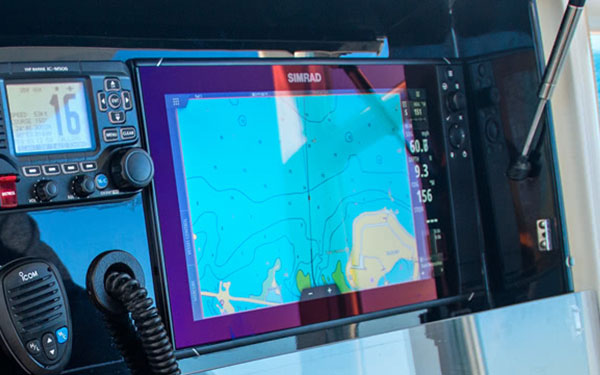
A real 'do-it-all'! SIMRAD 's RS40-B VHF radio has an integrated GPS antenna, a built-in AIS transmitter/receiver and boasts versatile connectivity. A large display with an intuitive user interface ensures clear and simple operation.
We are happy to programme the radio with your boat-data. Simply click "Add programming" and complete the form. Product details
We are happy to programme the radio with your boat-data. Simply click "Add programming" and complete the form. Product details
Recommended retail price:
€1,307.81
only
€1,099.95
-16%
You save: €207.86
Do you require programming?
Would you like to customise your programming?
Available on 08.06.2026
Customised products approx. 2-5 working days

Are you already using this item?
Add to my boat now.


Product data
- SVB item number 81777
- EAN 9420024175910
- Manufacturer no. 000-14818-001
- Description SIMRAD - RS40-B VHF radio / with integr. AIS transponder and GPS antenna
- Radio Type Fixed installation
- DSC Yes
- ATIS Yes
- GPS Yes
- AIS Transmitter Yes
- AIS receiver Yes
- NMEA0183 Yes
- NMEA2000 Yes
- Black Box No
- Connectable to second device Yes
- Installation width 192 mm
- Installation height 79.5 mm
- Installation depth 137 mm
- ARC approved Yes, mandatory
- Backlight White
- Intercom Yes
- Connector PL Socket
- ATIS number input By customer
- MMSI number input By customer
- Transmission power 1 W, 25 W
- Programmable Yes
- Operating voltage 12 V


Accessories


Product details
Notes on programming:
This device has to be programmed with your personal data, such as: MMSI and/or ATIS numbers.
It is possible to program the MMSI and ATIS number yourself. The relevant instructions can be found in the manual.
Alternatively, we can programme the device for you. For this we charge a programming fee.
If you would like us to programme the device, please let us know as you are making your order. Please add the above-mentioned programming accordingly and complete the form in full.
If additional channels (e.g. the Dutch channels) are to be activated, we charge our programming fee. The fee is only charged once per device.
The application for the allocation of the MMSI and ATIS number can be found in our Service/Downloads section.
This device has to be programmed with your personal data, such as: MMSI and/or ATIS numbers.
It is possible to program the MMSI and ATIS number yourself. The relevant instructions can be found in the manual.
Alternatively, we can programme the device for you. For this we charge a programming fee.
If you would like us to programme the device, please let us know as you are making your order. Please add the above-mentioned programming accordingly and complete the form in full.
If additional channels (e.g. the Dutch channels) are to be activated, we charge our programming fee. The fee is only charged once per device.
The application for the allocation of the MMSI and ATIS number can be found in our Service/Downloads section.
A real 'do it all'!! SIMRAD 's RS40-B VHF radio has an integrated GPS antenna, a built-in AIS transmitter/receiver and boasts versatile connectivity. A large display with an intuitive user interface ensures clear and simple operation. The display has been visually adapted to the design of SIMRAD multifunctional displays.
Integrated AIS transponder
The RS40-B's built-in AIS transponder can receive position data from other ships in the same way as the RS40, but can also transmit its own position to nearby ships equipped with AIS. This increases situational awareness and avoids collisions. Position data is clearly visible on the RS40-B display and can be superimposed on a chart or radar image using a compatible chartplotter.
IMPORTANT:
A second FM antenna or splitter is required to use the AIS function. Please refer to our product recommendations.
Four possibilities for GPS reception
With its integrated GPS receiver, the RS40-B offers four ways to ensure GPS use in an emergency. The GPS antenna on the front of the radio is perfect for open sky installations, and the SMA connector connects to the supplied GPS-500 antenna. NMEA0183 and NMEA2000 connectors allow the user to receive GPS data from a chartplotter or other antenna already installed in the system. To use the AIS transmitter, the supplied external GPS-500 antenna must be connected.
Wireless handset
Up to two wireless handsets can be connected. One wireless handset allows you remote access to the radio system and you can easily take it on board anywhere.
The H60 wireless handset is available separately.
Remote-mountable handheld microphone
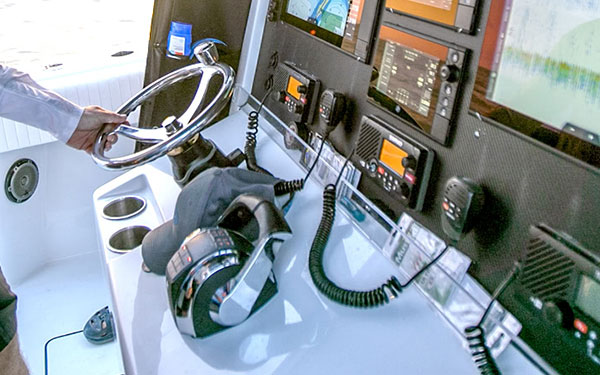
A further novelty is the remote mountable hand-held microphone. This hand-held microphone can be mounted on the front or back of the radio at any time. This makes the radio system flexible and suitable for any location.
Track buddy
Track Buddy is a feature that automatically retrieves the location of any other VHF radio. Simply enter a desired MMSI number into your contact list and start tracking! This function allows you to track up to five friends at different intervals.
Technical specifications
| Operating temperature | -15°C to +55°C |
| Power supply | 12 V DC |
| Power consumption when receiving | <1.5 A |
| Power consumption when transmitting | <6 A at high transmission power (at 13.6 V voltage) / <1.5 A at low transmission power (at 13.6 V voltage) |
| Frequency range: transmit | 156.025 to 157.425 MHz |
| Frequency range: receive | 156.050 to 163.275 MHz |
| Digital Selective Calling (DSC): Receiving | Class D |
| NMEA0183 | Yes |
| NMEA2000 | Yes |
| GPS | Yes - via external GPS-500 antenna |
| AIS transmitter / receiver | Yes, integrated |
| Waterproof | IPX7 |
| Dimensions | 201.2 x 97.8 x 163.3 mm |
Note
The DSC or ATIS function/menu is only available in the respective channel group. Please change to the corresponding channel group to use the respective functions.
Delivery contents
- VHF marine radio RS40-B
- External GPS-500 GPS antenna
- Hand-held microphone
- Mounting bracket
- Installation seal
- Suncover
- Knurled screws
- Cover frame
- 8 A fuse
- Bulkhead holder for handheld microphone
- Fixing screws
- Documentation
Documents


Product safety

by
Pavel P.
 5/27/2022
Verified purchase
5/27/2022
Verified purchase
5/27/2022
Verified purchase


Customers ask customers
Technical question
Oleksandr B.
| Apr 10, 2024

Hi! Currently I have VHF antenna+ fm spliter+ VHF radio. If VHF radio is replaced with Simrad rs40-b, Will I need a splitter? Will FM radio still work? Thank you in advance.
Answer from SVB customer service
Karen S.
| Apr 26, 2024

Dear Oleksandr, two FM antennas can be connected to the RS40B or one FM antenna with a splitter. In this case, you must keep the splitter, as there is no splitter integrated in the RS40B.
Technical question
Cyprian K.
| Jul 20, 2021
Will the GPS-500 antena feed the signal to the rest of NMEA2000 devices? I'm planning to hook it up to Garmin plotter.


It will send the position vie N2k to the network. With connected GPS500 (external) passive antenna) and also with only internal GPS-receiver receiving. The output NMEA2000 PGN is standard, but I can't say whether the "foreign" plotter is able to select the position source (VHF) in the menu.

Customers also bought
-34%

KUS
NMEA2000 Tank Sensor
€171.67
from
€112.95
8 variants
Program online

-10%
ICOM
IC-M330GE VHF DSC Marine Radio
€323.13
only
€289.95
28
-19%
SIMRAD
Wireless Handset HS40
€296.31
only
€239.95
2
Program online
-13%
ICOM
DSC and ATIS Radio System IC-M423GE / integr. GPS
€448.43
only
€389.95
6
Program online
STANDARD HORIZON
GX1400G VHF Marine Radio
only
€221.95
13
Program online
-14%
ICOM
IC-M94DE Handheld Radio / incl. AIS Receiver and DSC
€453.08
only
€389.95
Similar items
Program online
-10%
ICOM
IC-M330GE VHF DSC Marine Radio
€323.13
only
€289.95
28
Program online
-13%
ICOM
DSC and ATIS Radio System IC-M423GE / integr. GPS
€448.43
only
€389.95
6
-14%
ICOM
VHF Marine Bundle IC-M423 & Handheld Radio IC-M25 / black
€664.45
only
€569.95
6
-14%
ICOM
VHF Marine Bundle IC-M423 & Handheld Radio IC-M25 / blue
€664.45
only
€569.95
6
Program online
ICOM
IC-M510E EVO VHF Marine Radio with integrated GPS receiver
only
€779.95
2
Program online
ICOM
IC-M510E EVO VHF Marine Radio with integrated AIS receiver
only
€839.95
2
Program online
-13%
ICOM
IC-M605EURO VHF Marine Transceiver / with AIS and GNSS Receiver
€1,270.72
only
€1,099.95
2
Program online
STANDARD HORIZON
GX1400G VHF Marine Radio
only
€221.95
14
Program online
-10%
STANDARD HORIZON
GX2400E GPS VHF Marine Radio
€568.21
only
€513.95
Program online
-19%
RAYMARINE
Ray53 VHF Maritime Radio / integr. GPS receiver
€493.85
only
€399.95
30
Last seen products
MERCURY
JET Main 2.5 HP 898101364
only
€9.95
1
VAGNON
Réussir sa sortie en mer - Voile ou moteur
only
€19.95
4
Program online
-11%
RAYMARINE
RAY91 Black Box VHF Radio / with AIS receiver
€1,303.05
only
€1,159.95
2
BAVARIA
Thermo Blackout Blind / 575 x 550 mm
only
€117.95
-15%
SUZUKI
DF 15 L Outboard Motor / Long Shaft / Manual Start
€3,645.01
only
€3,089.95
ROCA
Foldable Fitting / up to 150 kg / stainless-steel, polished
only
€82.95
40
Prop Cone for Volvo Penta Z-Drive 270-290 / SP / AQ200-290
only
€64.95
4
-13%
JABSCO
Solenoid Valve for WC / 12 V
€241.81
only
€209.95
8
E-mail Newsletter
Product news, offers & new guide videos. Stay up to date!
WhatsApp
New: Get news from SVB straight to your phone!