
















TRUE HEADING CTRX-VISION+ SOTDMA AIS Transponder / 5W transmit power / integr. splitter / NMEA2000 / GPS antenna
SVB item number: 95591
Manufacturer no.: CTRX-VISION+


The TRUE HEADING CTRX VISION+ is a modern 5 watt AIS Class B transponder that uses the SOTDMA protocol. Just like the AIS Class A transponders, the CTRX VISION+ also uses the time slot reservation method so that there is always a free time slot available to transmit its position with a higher transmission power of 5 watts and a faster update rate than conventional AIS transponders.
We are happy to programme the radio with your boat-data. Simply click "Add programming" and complete the form. Product details
We are happy to programme the radio with your boat-data. Simply click "Add programming" and complete the form. Product details
Recommended retail price:
€1,046.01
only
€949.95
-9%
You save: €96.06
Do you require programming?
Would you like to customise your programming?
15
| in stock

Are you already using this item?
Add to my boat now.
Available variants

TRUE HEADING
CTRX-VISION+ WiFi AIS SOTDMA Transponder / 5W transmit power / integr. splitter / NMEA2000 / GPS antenna
€1,307.81
only €1,149.95
Customised products approx. 2-5 working days
Are you already using this item?
Add to my boat now.
Available variants
TRUE HEADING
CTRX-VISION+ WiFi AIS SOTDMA Transponder / 5W transmit power / integr. splitter / NMEA2000 / GPS antenna
€1,307.81
only €1,149.95


Product data
- SVB item number 95591
- Manufacturer no. CTRX-VISION+
- Description TRUE HEADING - CTRX-VISION+ AIS Transponder
- Communication type Transmitter/Receiver
- Class Class B
- SOTDMA capability Yes
- Tx power 5 W
- Integrated VHF splitter Yes
- GPS Yes
- NMEA2000 Yes
- NMEA0183 Yes
- WiFi No
- USB Yes
- DAB No
- DVB-T2 No
- FM radio No
- Ethernet / Network No
- SD card slot No
- MMSI number input By customer
- Programmable Yes
- Operating voltage 12 V, 24 V
SVB recommends


Product details
Note:
The AIS receiver can be programmed by yourself. If you still want the device to be programmed by us, we will charge our programming fee for this service.
Please add the above-mentioned programming accordingly and complete the form in full.
The AIS receiver can be programmed by yourself. If you still want the device to be programmed by us, we will charge our programming fee for this service.
Please add the above-mentioned programming accordingly and complete the form in full.
Modern SOTDMA AIS transponder
The TRUE HEADING CTRX VISION+ is a modern 5 watt AIS Class B transponder that uses the SOTDMA protocol. Just like the AIS Class A transponders, the CTRX VISION+ also uses the time slot reservation method so that there is always a free time slot available to transmit its position with a higher transmission power of 5 watts and a faster update rate than conventional AIS transponders.
Switch the AIS transponder to " silent mode" and you can suppress the transmission of your AIS data while still being able to receive AIS data.
Integrated antenna splitter
Save yourself the trouble of installing an additional antenna cable and finding a suitable installation location for an additional VHF antenna. The CTRX VISION+ has a built-in high-performance antenna splitter, which makes it possible to use your existing VHF marine radio antenna for loss-free transmission and reception of radio messages and AIS data.
Easy installation
Thanks to its compact design and low weight, the TRUE HEADING CTRX VISION+ can be installed quickly and easily with concealed mounting. The PL-SO 239 sockets provided for the antenna and radio connection are compatible with PL-259 plugs most commonly fitted to antenna cables.
The AIS SOTDMA transponder can also be connected to a chart plotter or on-board network in a variety of ways. NMEA2000 Micro-C, serial NMEA0183 and USB interfaces allow for multiple connection options.
The CTRX VISION+ / WiFi can be easily programmed with your personal data using the proAIS2 software. Download the software free of charge from the manufacturer's website.
High-quality GPS antenna included
The high-quality 72-channel GPS antenna included determines current position precisely and reliably at all times. The GPS antenna is connected directly via the TNC connection.
What is the AIS SOTDMA access scheme?
AIS signals are transmitted using two main methods: CSTDMA (Carrier Sense Time Division Multiple Access) and SOTDMA (Self Organising Time Division Multiple Access).
With conventional CSTDMA, the system checks the availability of a free slot before transmitting AIS information. If no slots are free, the system waits until a free slot becomes available. This can lead to a long waiting time before the transmitted AIS signal can be sent.
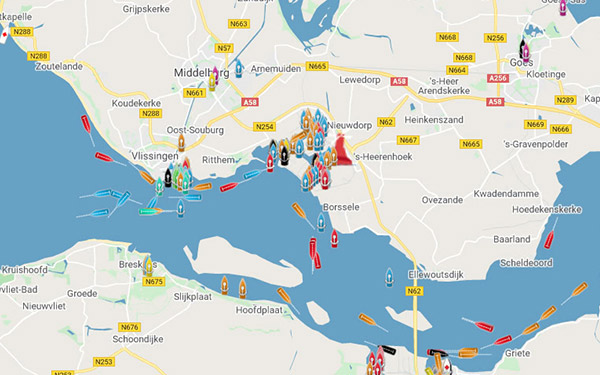
By contrast, SOTDMA transmissions are more structured. Here, each transmitted AIS signal is coordinated and prioritised with other signals. Instead of waiting for the next free slot, an additional slot is reserved for the next SOTDMA signal. This leads to more structured and more frequent transmissions compared to the conventional CSTDMA method. The AIS - SOTDMA system has a clear advantage over the CSTDMA system, especially in heavily frequented areas such as the English Channel and the waterways around large harbours such as Rotterdam. In addition, SOTDMA AIS transponders operate with an increased transmission power of 5 watts, which significantly increases the range of the transponder.
All connections at a glance
Technical Data


The TRUE HEADING CTRX VISION+ is a modern 5 watt AIS Class B transponder that uses the SOTDMA protocol. Just like the AIS Class A transponders, the CTRX VISION+ also uses the time slot reservation method so that there is always a free time slot available to transmit its position with a higher transmission power of 5 watts and a faster update rate than conventional AIS transponders.
Switch the AIS transponder to " silent mode" and you can suppress the transmission of your AIS data while still being able to receive AIS data.
Integrated antenna splitter
Save yourself the trouble of installing an additional antenna cable and finding a suitable installation location for an additional VHF antenna. The CTRX VISION+ has a built-in high-performance antenna splitter, which makes it possible to use your existing VHF marine radio antenna for loss-free transmission and reception of radio messages and AIS data.
Easy installation
Thanks to its compact design and low weight, the TRUE HEADING CTRX VISION+ can be installed quickly and easily with concealed mounting. The PL-SO 239 sockets provided for the antenna and radio connection are compatible with PL-259 plugs most commonly fitted to antenna cables.
The AIS SOTDMA transponder can also be connected to a chart plotter or on-board network in a variety of ways. NMEA2000 Micro-C, serial NMEA0183 and USB interfaces allow for multiple connection options.
The CTRX VISION+ / WiFi can be easily programmed with your personal data using the proAIS2 software. Download the software free of charge from the manufacturer's website.
High-quality GPS antenna included
The high-quality 72-channel GPS antenna included determines current position precisely and reliably at all times. The GPS antenna is connected directly via the TNC connection.
What is the AIS SOTDMA access scheme?
AIS signals are transmitted using two main methods: CSTDMA (Carrier Sense Time Division Multiple Access) and SOTDMA (Self Organising Time Division Multiple Access).
With conventional CSTDMA, the system checks the availability of a free slot before transmitting AIS information. If no slots are free, the system waits until a free slot becomes available. This can lead to a long waiting time before the transmitted AIS signal can be sent.
By contrast, SOTDMA transmissions are more structured. Here, each transmitted AIS signal is coordinated and prioritised with other signals. Instead of waiting for the next free slot, an additional slot is reserved for the next SOTDMA signal. This leads to more structured and more frequent transmissions compared to the conventional CSTDMA method. The AIS - SOTDMA system has a clear advantage over the CSTDMA system, especially in heavily frequented areas such as the English Channel and the waterways around large harbours such as Rotterdam. In addition, SOTDMA AIS transponders operate with an increased transmission power of 5 watts, which significantly increases the range of the transponder.
Note: You can programme the AIS receiver yourself. However, if you would like us to programme the device, we charge our programming fee for this service.
The application for allocation of the MMSI can be found in our Service / Downloads section.
The application for allocation of the MMSI can be found in our Service / Downloads section.
All connections at a glance
| 1 | NMEA2000 Micro-C (male) |
| 2 | Power supply, NMEA0183 (input/output), USB |
| 3 | VHF radio (PL socket SO-239) |
| 4 | VHF antenna (PL socket SO-239) |
| 5 | GPS antenna (TNC socket) |
Technical Data
| Operating voltage | 12 V - 24 V DC |
| Current consumption: | < 220 mA at 12 VDC |
| Interfaces: | NMEA2000 Micro-C (male) NMEA0183 output (38,400 baud) NMEA0183 input (4,800 baud) USB |
| Connections: | VHF antenna input PL socket SO-239 VHF antenna output PL socket SO-239 NMEA2000 Micro-C (male) GPS GNSS antenna connection TNC socket 12-pin connector for power supply, NMEA0183 (input/output), USB and "silent mode" |
| LED displays: | Power, TX Timeout, Error and "Silent Mode" |
| GPS GNSS receiver: | 72 channel GPS-GLONASS-SBAS receiver incl. 10 metre connection cable |
| Dimensions: | 173 x 128 x 53 mm (L x W x H) |
| Weight: | 380 g (only the AIS transponder without accessories) |
Features
Discover the features that make this product stand out. From technical details to special functions – we’ve summarized all the key information for you.
Class B
GPS
Yes
Delivery contents
- TRUE HEADING CTRX-VISION+ AIS SOTDMA Transponder
- GPS Antenna
- Power/data cable
- VHF connection cable (PL-259 connector on both sides)
- Installation material
- Documentation

Documents


Systems
Product safety


Customers ask customers
No questions asked yet. Be the first to ask a question!
More "Customers ask customers" available in the following languages
Comparison


Availability / Price
Item no.
95591
95592
Customer ratings
Description
TRUE HEADING - CTRX-VISION+ AIS Transponder
TRUE HEADING - CTRX-VISION+ WiFi AIS Transponder
NMEA0183
NMEA2000
Ethernet / Network
WiFi
GPS
Communication type
Transmitter/Receiver
Transmitter/Receiver
Integrated VHF splitter
SOTDMA capability
Class
Class B
Class B
SD card slot
USB
Tx power
5 W
5 W
Operating voltage
12 V, 24 V
12 V, 24 V
DAB
DVB-T2
MMSI number input
By customer
By customer
FM radio
Programmable
Similar items
Program online

-12%

TRUE HEADING
CTRX-VISION+ WiFi AIS SOTDMA Transponder / 5W transmit power / integr. splitter / NMEA2000 / GPS antenna
€1,307.81
only
€1,149.95
7
Program online
-23%
RAYMARINE
AIS Transmitter/Receiver AIS700 with SOTDMA & Splitter
€1,422.05
only
€1,099.95
> 11
Program online
AMEC
AIS SOTDMA Transponder B600S / integr. splitter / GPS patch antenna
only
€949.00
> 17
AMEC
CYPHO150S AIS Receiver
only
€439.95
7
Program online
NEW
WEATHERDOCK
AIS-Transponder easyTRX3S Gen.2
only
€1,079.95
7
Program online
-20%
NAVICO
NAIS-500 AIS-Transponder
€986.51
only
€789.95
2
Program online
-21%
NAVICO
NAIS-500 AIS-Transponder / incl. NSPL-500 Splitter
€1,307.81
only
€1,029.95
Expected to be in stock within 1-2 weeks
Program online
-13%
ICOM
MA-510TR AIS Transponder with Display and GPS Antenna
€1,112.88
only
€969.95
2
Program online
-8%
DIGITAL YACHT
iAISTX Plus SOTDMA AIS Transponder with GV30 GPS-AIS Combi Antenna
€1,201.90
only
€1,099.95
Available on 08.06.2026
Program online
-6%
DIGITAL YACHT
NOMAD 2 Portable SOTDMA AIS Transponder / 5 W Transmission Power / including VHF & GPS combo antenna
€1,065.05
only
€999.95
Expected to be in stock within 2-3 weeks
Last seen products
-8%
SEAEQ
PERFORMER WP Dock Fender / light grey / 600 x 500 x 300 mm
€421.90
only
€388.95
JOCKEL
Foam Fire Extinguisher / 6 litre / fire classes AB / manual / fluorine-free
only
€236.95
2
JOHNSON PUMP
Pump Cover for Seawater Pump F6B
only
€14.95
6
JOHNSON PUMP
Seawater Pump / Impeller Pump for Volvo Penta 2001 / 2002 / 2003
only
€314.95
3
-13%
LIQUI MOLY
Marine 4T Motor Oil 10W-40 / 5 L
€64.30
only
€55.95
(€11.19 / L)
22
-12%
HELLA MARINE
Series 2984 Bicolour Light
€79.14
only
€69.95
9
E-mail Newsletter
Product news, offers & new guide videos. Stay up to date!
WhatsApp
New: Get news from SVB straight to your phone!