
















OCEAN SIGNAL RescueME EPIRB3 / with AIS and RLS function
SVB item number: 29821
Manufacturer no.: 7025-03932


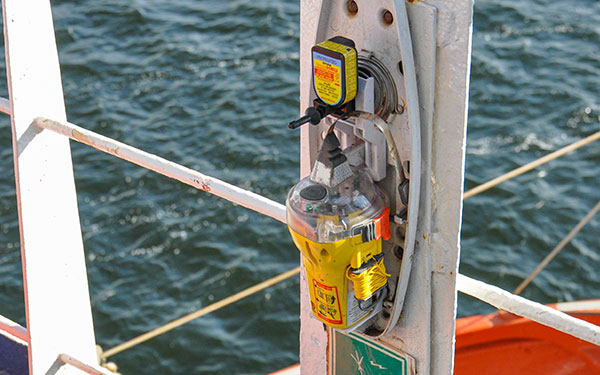
The new Ocean Signal EPIRB3 rescue transmitter combines 406 MHz, 121.5 MHz and AIS distress messaging in one and is 30% smaller than its predecessor, the EPIRB1. By combining the individual technologies for making emergency calls, the chances of a quick rescue are significantly increased. Using the wireless NFC connection, you can access activity history, battery status programming information of the EPIRB3 using an app. Product details
Recommended retail price:
€1,049.58
only
€969.95
-8%
You save: €79.63
Shipping information:
Dangerous goods
Would you like to customise your programming?
available
| in stock
Select your programming now
About the boat
MMSI *
MMSI number invalid
Call sign *
3–7 characters (A–Z, 0–9)
Boat name *
Please fill out correctly
About the owner
Name *
No numbers or special characters (except “-”, “.” and “”') allowed
Street name and house number *
No numbers or special characters (except “-”, “.”, “,”, “/”) allowed
Postal code and city *
No numbers or special characters (except “-”, “.”, “,”, “/”) allowed
Country *
1. Phone number *
International format, e.g. +49572900
2. Phone number
International format, e.g. +49572900
E-mail *
Please fill out correctly
Emergency contacts
First emergency contact
Name *
No numbers or special characters (except “-”, “.” and “”') allowed
1. Phone number *
International format, e.g. +49572900
2. Phone number
International format, e.g. +49572900
Second emergency contact
Name *
No numbers or special characters (except “-”, “.” and “”') allowed
1. Phone number *
International format, e.g. +49572900
2. Phone number
International format, e.g. +49572900
Fields marked with * are mandatory
Customised products approx. 2-5 working days

Are you already using this item?
Add to my boat now.
At a glance!


Product data
- SVB item number 29821
- EAN 5060266111419
- Manufacturer no. 7025-03932
- Description Ocean Signal - rescueME EPIRB3
- Trigger Automatic & manual
- Transmitting time 48 h
- Tx power 5 W
- Frequencies 406 / 121.5 MHz
- Battery Life 10 Years
- Change battery yourself No
- Programmable Yes
- GPS Yes
- RLS Yes
- AIS Support Yes
- Float-free mount No
- Weight Not specified
- MMSI number input By seller
- Hedging target The boat gets into distress
- Emergency receiver Boats in the vicinity, Rescue coordination center
- Worldwide alerting Yes
- Signal transmission Satellite, VHF
- Shipping information Dangerous goods
Product details
Notes on programming:
This EPIRB must be programmed with your personal data, at least the MMSI, the boat name and your callsign, before it is dispatched. The appliance will not function without prior programming.
The programming of this data must be carried out by us, you cannot do this yourself.
Please add the above-mentioned programming accordingly and complete the form in full.
We would also like to point out that, in accordance with the regulations of the respective country, you must register the EPIRB personally as the licence holder with the competent authority.
This EPIRB must be programmed with your personal data, at least the MMSI, the boat name and your callsign, before it is dispatched. The appliance will not function without prior programming.
The programming of this data must be carried out by us, you cannot do this yourself.
Please add the above-mentioned programming accordingly and complete the form in full.
We would also like to point out that, in accordance with the regulations of the respective country, you must register the EPIRB personally as the licence holder with the competent authority.
The new Ocean Signal EPIRB3 rescue transmitter combines 406 MHz, 121.5 MHz and AIS distress messaging in one and is 30% smaller than its predecessor, the EPIRB1. By combining the individual technologies for making emergency calls, the chances of a quick rescue are significantly increased.
The Ocean Signal EPIRB3 is triggered manually using a button, which is protected against false triggering by a corresponding cap.
Wireless NFC interface
Using the NFC wireless connection*, you can access activity history, battery status and programming information of the EPIRB3 via the OceanSignal app (iOS and Android). * Note: Only possible with an NFC (Near Field Communication) compatible smartphone.
Compact design with additional infrared strobe light
All functions and, of course, the lithium-ion battery, which enables an operating time of at least 48 hours (at -20 °C), as well as the 72-channel GPS receiver, are contained in the compact housing design. With the dimensions of 89 x 89 x 178 mm (H x W x D) and its range of functions, the Ocean Signal EPIRB3 is ideal for is ideal for small to medium-sized boats and with the wall bracket included in the delivery contents, the Ocean Signal rescueME EPIRB3 is always ready to hand in the event of an emergency.
In addition to a powerful strobe light, the EPIRB3 also has an additional infrared strobe light, which makes it easier to find the casualty in bad weather and at night.
Integrated AIS function
When the Ocean Signal rescueME EPIRB3 is triggered, in addition to sending a distress message on the typical EPIRB frequencies of 406 MHz and 121.5 MHz, an AIS distress message is also sent to vessels in the vicinity via the VHF AIS frequencies. This AIS distress message can be received by vessels equipped with an appropriate AIS Class A or Class B receiver. The AIS distress message is displayed on the compatible navigation system and the course can be taken directly to the position of the distress call.
The merging of 406 MHz and AIS distress messaging effectively pairs both global and local rescue, thereby maximizing access to the most effective rescue resources available.
RLS function
The RLS (Return Link Service) function is a two-way communication type between your EPRIB and the rescue centre. The RLS system gives you the peace of mind that your distress message, which was sent via the EPIRB frequency, has been received by the rescue coordination center. As soon as your distress message is received by the responsible authority, the RLS LED on the Ocean Signal EPIRB3 lights up blue. The RLS signal is sent via the Galileo satellite network from the rescue control centre back to the EPIRB, which triggered the distress message. This confirmation that rescuers are aware that an EPIRB has been activated and know its location helps reduce the stress associated with accident situations.

Technical Data
| General | |
| Dimensions: | 178 x 89 x 89 (H x W x D) |
| GPS Receiver: | 72 72 channel, GPS / Galileo and Glonass compatible |
| Battery: | Lithium ion / running time when activated +48 hours @ -20 °C / durability 10 years |
| 406 MHz Transmitter | |
| Frequency: | 406.031 MHz (+/- 1 KHz) |
| Transmission power: | 5W typical |
| RLS (Return Link Service): | Only available in countries where RLS is allowed. You can find more information about the RLS approval in the respective countries on the Cospas Sarsat website. |
| 121.5MHz Transmitter | |
| Frequency: | 121.5 MHz |
| Transmission power: | 25 - 10 MW PEP |
| Modulation: | Swept Tone AM (3K20A3X) |
| AIS Transmitter | |
| Frequency: | 161.975 / 162.025 MHz (+/- 500 Hz) |
| Transmission power: | 1 W |
| Baud rate: | 9600 bauds |
| AIS message: | Message 1 (position) and message 14 (MOB status) |
Documents
 Certificate
PDF (212,58 KB)
Certificate
PDF (212,57 KB)
Certificate
PDF (80,46 KB)
Certificate
PDF (633,54 KB)
Datasheet
PDF (2,99 MB)
Manual
PDF (1,66 MB)
Product safety
Customers ask customers
Technical question
Andrey P.
| Feb 12, 2023


Hi, we need to get a MMSI . In order to complete a form we need to know the 15 character code provided by the EPIRB manufacturer. Also the name of manufacture. We need it ASAP. As we receive a MMSI we fill out your form to program EPIRB before you ship it. Thank you, Andrey.
Answer
Andrey P.
| Feb 13, 2023
Please email me the EPIRB code.
Similar items
Program online

-9%

OCEAN SIGNAL
Emergency Beacon EPIRB1
€699.72
only
€634.95
Program online
-7%
ACR
EPIRB GlobalFIX V5 / with AIS and RLS function
€1,094.84
only
€1,019.95
Program online
ACR
EPIRB GlobalFIX V5 / with AIS and RLS function / FloatFree mount
only
€1,119.95
Program online
-8%
ACR
EPIRB GlobalFIX V6 / with RLS function
€819.37
only
€753.95
Available on 18.06.2026
Program online
ACR
EPIRB GlobalFIX V6 / with RLS function / FloatFree mount
only
€1,079.95
Last seen products
-20%
SEATEC
LED Reading Light with touch switch and USB-C charging port
€74.95
only
€59.95
96
69 - Repair Kit for Hand Pump
BAVARIA
BLUMOTION Adapter Plate, straight (20/32), plastic
only
€2.95
-8%
BAVARIA
Thermostat for Volvo Boiler
€21.66
only
€19.95
Heating rod 220 V / for hot water boilers by Plastimo
Service Plate for PFF12 and ST114
only
€5.95
6
-28%
BAVARIA
Dish rinser for single lever sink
€17.99
only
€12.95
PFEIFFER
Dual Dock Post - Natural Aluminum
only
€106.95
5
E-mail Newsletter
Product news, offers & new guide videos. Stay up to date!
WhatsApp
New: Get news from SVB straight to your phone!